The
Menopause
Blueprint.
A field guide to training, nutrition, and mindset through pre, peri, meno & post‑menopause. Built for women who refuse to slow down.

A note before we begin.
Menopause is not a malfunction. It's a transition. Biological, hormonal, identity-level. It lasts a decade or more for most women. You don't need to white‑knuckle through it. You need a plan.
This blueprint is the same framework we use with CSF coaching clients, adapted for the four stages of the menopause continuum. Whether you're 38 with subtly heavier periods, 47 with brain fog and night sweats, or 60 and rebuilding bone density after a decade post‑meno, there's a chapter here for you.
Use the stage filter at the top of this page to tune content to where you are right now. The principles don't change: strength, protein, sleep, movement, mindset. But the dose does.

Joseph Ochoa
Founder & Head Coach, CSF
Three things to do this week.
You don't need to read all 22 chapters before you start. Do these three, then come back for the rest.
What's inside.
Strength is the closest thing we have to a menopause drug. And it's free.
The four stages.
Premenopause
Regular cycles, estrogen and progesterone at full strength. The window to build the muscle, bone, and habits that will carry you through every stage that follows.
- Build peak bone mass
- Establish strength baseline
- Lock in sleep & stress habits
Perimenopause
Hormones fluctuate wildly. Cycles shorten, lengthen, skip. The phase where most women first notice "something is different," and where the right plan changes everything.
- Manage symptoms, not chase them
- Protect muscle & insulin sensitivity
- Sleep becomes non‑negotiable
Menopause
A single point in time: the 12-month anniversary of your final period. Estrogen has settled at a new, lower baseline. Symptoms often peak here, then begin to ease.
- Heavy lifting becomes essential
- Bone & cardiovascular focus
- Recalibrate maintenance calories
Postmenopause
The longest stage, often 30+ years. Hot flashes fade for most. The work shifts to long‑term resilience: bone density, balance, cognition, and cardiovascular health.
- Train for the next 30 years
- Power & balance work added
- Cognition + community matter
Hormones, plotted.
The architect.
Builds bone, protects the heart and brain, keeps joints lubricated, and sharpens insulin sensitivity. The drop is the headline event of menopause, and the reason strength training becomes non-optional.
The settler.
Calms the nervous system, supports sleep, and balances estrogen. Often the first hormone to decline. That's why "I just can't sleep like I used to" is frequently the earliest perimenopause signal.
The engine.
Drives libido, motivation, muscle, and confidence. Declines gradually from the late 20s onward. Which is why lifting heavy gets more important, not less, with each decade.
Symptom tracker.
Tap the symptoms you notice. Your read-out shows up here.
Recognize 5 or more of these?
That's exactly what the strategy call is for. One hour, free, no pitch. We look at your symptoms and map out what to do next.
Nutrition, reframed.
Eat at your TDEE for 3–4 weeks. Weight stable? That's home base. This is where most menopausal women should live. Not in a deficit.
Hit your protein target first. Every meal, every day. Carbs and fat fill what's left. Protein is the only macro your body cannot store.
If fat loss is the goal: 10–15% below maintenance, 8–12 weeks max, then reverse back to maintenance. Aggressive cuts in peri/meno wreck sleep, mood, and muscle.
Protein targets.
It quite literally has changed my and my husband's life.
- 2 to 12+ push-ups
- Her husband lost 35 lb
Foods to lean into.
Eat often
Protein · Fiber · Phytoestrogens- Salmon, sardines, mackerel
- Eggs (whole)
- Greek yogurt, cottage cheese
- Lean beef & bison
- Chicken & turkey
- Tofu, tempeh, edamame
- Lentils & black beans
- Ground flaxseed
- Berries (all colors)
- Cruciferous greens
- Sweet potato & squash
- Oats, quinoa, brown rice
- Avocado, olive oil, nuts
- Bone broth
- Fermented foods (kimchi, kefir)
- Dark chocolate (85%+)
Eat with intention
Time it · Don't fear it- Alcohol (disrupts sleep + hot flashes)
- Caffeine after 2 PM
- Ultra‑processed snack foods
- Refined sugar & flour
- Seed‑oil‑heavy fried foods
- Late‑night carbs (insulin)
- Energy drinks & "diet" sodas
- Very low‑fat dairy (you need fat)
A sample day.
Greek Yogurt + Berry Bowl
1.5 cups 2% Greek yogurt · ¾ cup mixed berries · 2 tbsp ground flax · 2 tbsp walnuts · drizzle of honey. The flax is non‑negotiable for hormone metabolism.
The "Big Lunch" Bowl
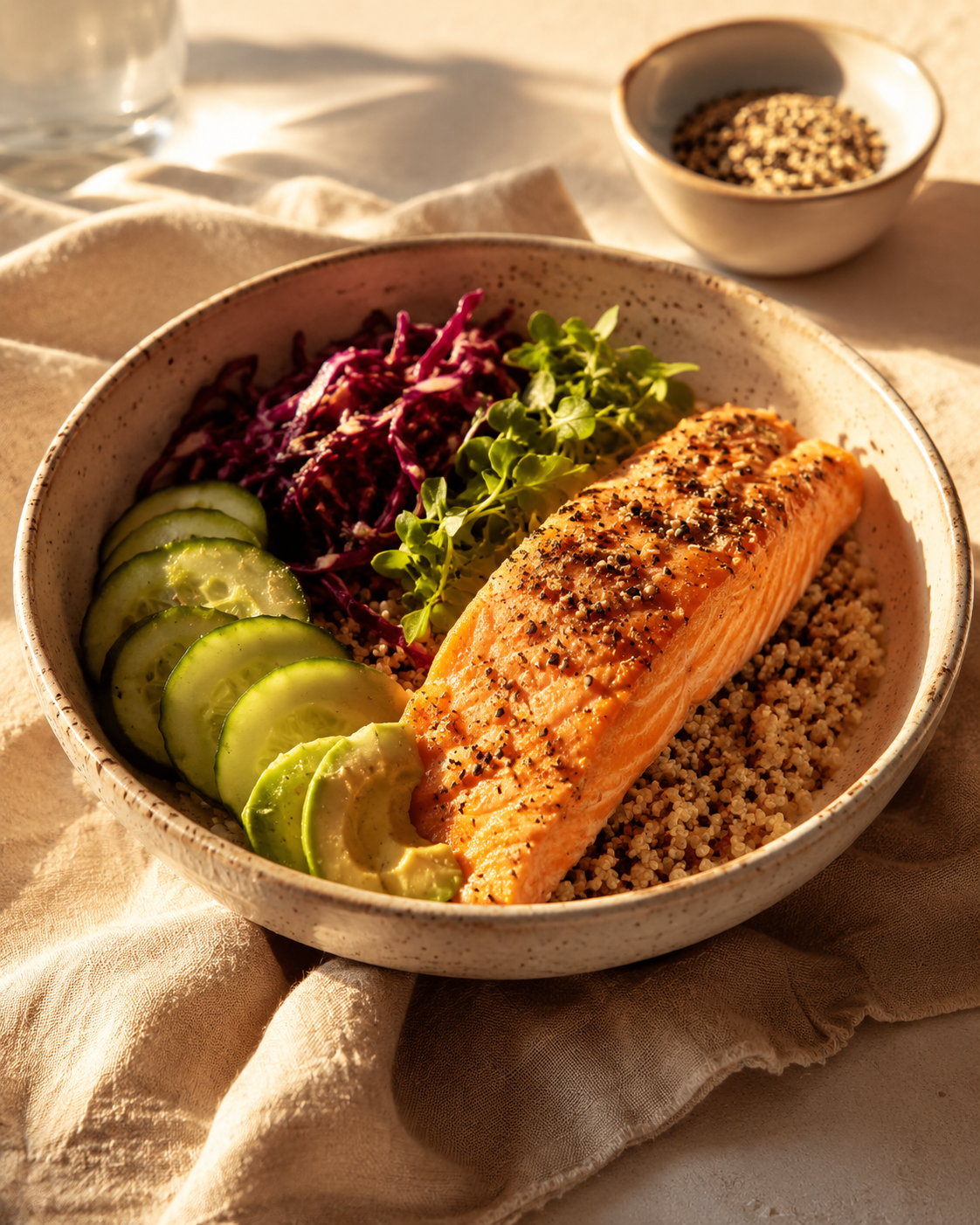
6 oz grilled salmon · 1 cup quinoa · roasted broccoli & sweet potato · ½ avocado · lemon‑tahini drizzle. Build it once Sunday, eat it twice this week.
Protein Snack
1 scoop whey or pea protein shake · 1 apple · 10 almonds. Bridges the gap so dinner doesn't become a binge.
Sheet‑Pan Chicken & Veg
6 oz chicken thigh · roasted Brussels sprouts, carrots, red onion · 1 cup lentils · olive oil & herbs. Bone‑protective, fiber‑forward, dishwasher‑friendly.
Tart Cherry "Nightcap"
8 oz unsweetened tart cherry juice + sparkling water. Natural melatonin precursor. Pairs well with the wind-down you'll read about on page 15.
Why lifting heavy matters.
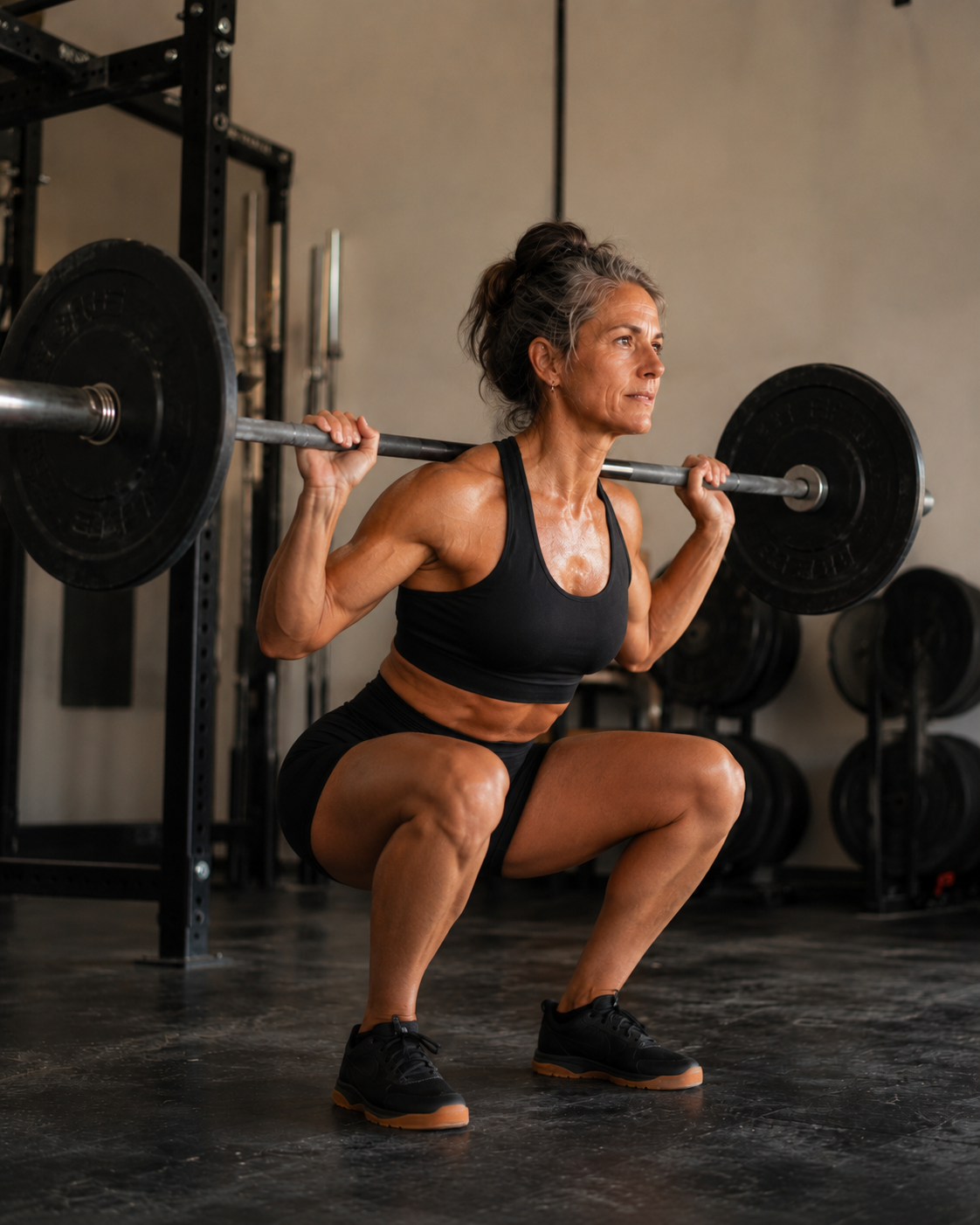
Heavy resistance training can build bone density at the hip and spine, even in postmenopausal women. No drug matches that without side effects.
Strength & balance work in women 60+ cuts fall risk by roughly 40%. Falls are the leading cause of injury death in this age group.
Average muscle gain in 6 months of progressive resistance training, even starting at 55+. Every pound of lean mass raises your metabolic floor.
The shift to heavy.
If the original CSF blueprint sold supersets and circuits as the answer, this version corrects course. Supersets are useful for time efficiency and conditioning. But they are not the primary tool for women in peri, meno, or post.
The primary tool is true strength work: 3–6 reps at 75–85% of your max on 4–6 compound lifts, with full rest between sets. Boring on paper. It works in practice.
You will not "get bulky." Without your premenopausal testosterone curve, that ship has sailed. What you will get: visible muscle definition, a metabolism that responds, and the bone density of someone a decade younger.
I have been involved with keeping myself active, and never saw any results like I saw in the last four months.
- 0 to 6 pull-ups
- Mile 2 minutes faster
The CSF Strength Plan.
Lower Day · "A"
Upper Day · "B"
I don't have to feel so guilty if I want that piece of chocolate.
- About 11 lb down
- Squat near 150 lb
- Scrubs fit better
Cardio, upgraded.
Zone 2
3–4× / week · 30–60 minThe "nose breathing" pace. Brisk walk, easy bike, light hike. You can hold a full conversation, barely. Builds mitochondrial density, insulin sensitivity, and cardiovascular resilience without spiking cortisol.
- Brisk outdoor walk · 4 mph
- Stationary bike, low resistance
- Hiking on rolling terrain
- Swimming at conversational pace
- Rucking 10–20 lb pack
Sprints / VO₂ Max
1× / week · 20 min totalShort, hard, fully recovered intervals. The single most efficient way to raise VO₂ max, the strongest predictor of all-cause mortality after 50. Twenty minutes once a week is enough.
- Bike sprints · 30 sec on, 90 sec off · ×10
- Hill sprints · 20 sec ×8
- Rower intervals · 250m ×6
- Assault bike · :30 / 1:30 ×8
- (Stair sprints if outdoors, joint friendly)
NEAT. The forgotten lever.
The floor. Not the goal. The floor.
Cuts post‑meal blood sugar by ~30%.
Stand and walk for 2 min after.
Turns a walk into a strength + cardio session.
- Walking meetings
- Park at the far end
- Stand desk, 50/50 split
- 10‑min after‑dinner walk
- Phone calls on foot
- Carry groceries in one trip
- Stairs always
- Garden, garage, walk the dog
- Saturday hikes
- Bike commute
- Pickleball league
- Dance class
Sleep, cortisol, recovery.
The 90‑minute wind‑down
Last food
Stop eating. Light protein snack OK; full meal not.
Lights down · screens off
Switch to warm lamps. Put the phone on a charger in another room.
Cool the body
Bedroom to 65–68°F. Warm shower (counterintuitive, but drops core temp after).
Down‑regulate
Read paper, journal, magnesium glycinate (300–400mg), tart cherry juice.
Lights out
Same time every night, ±30 min, including weekends. Consistency > duration.

Rate your weekly stress 1–10. Anything 7+ for 3+ days means strength training drops to 2× and zone 2 doubles. You cannot grow muscle in a fried nervous system.
Box breathing 4‑4‑4‑4 for five minutes before bed flips you into parasympathetic. Free, effective, and the only "supplement" backed by 40 years of vagal nerve research.
Optional, not foundational. Sauna 3× / week (15–20 min) is associated with better sleep and cardiovascular outcomes in women 50+. Cold plunge is up to you.
Pelvic floor & core.
Daily · 5 min
- Diaphragmatic breathing · 10 breaths, supine, hand on belly
- 360° breath + pelvic floor lift · inhale to expand, exhale to lift
- Dead bug · 10 slow reps each side
- Bird dog · 8 reps each side, full extension
Weekly · 2× 15 min
- Glute bridge with breath · 3×10
- Side plank · :20 / :30 / :40 build‑up
- Pallof press · 3×10/side
- Suitcase carry · 3×40 yd (lives in lifting day)
- Squat with intentional exhale on effort
If symptoms persist
- Leaking, prolapse pressure, painful intercourse, or low back pain that doesn't resolve = see a pelvic floor PT, not a regular PT.
- This specialty has exploded in the last decade. Insurance often covers it. Worth every minute of the intake.
Mindset & SMART goals.
A growth mindset for midlife.
The fixed mindset says: "My metabolism is broken. My body has changed. I'm too old for that now." All true on the surface. All false where it matters.
The growth mindset doesn't deny the change. It adapts to it. You're not training the body you had at 28. You're training the body you have, for the next thirty years.
| "My metabolism is broken." | I have less muscle than I did. Lifting fixes that. |
| "I'm too tired to work out." | The workout is what fixes the tired. |
| "I've tried everything." | I haven't tried heavy lifting + protein + sleep at the same time. |
| "It's too late." | The best time was twenty years ago. The second best is right now. |
A SMART goal that works.
Bad goal
"I want to lose weight and tone up."
Good goal
"By my birthday in June, I will deadlift my body weight for 5 reps, sleep 7 hours on at least 5 nights a week, and feel strong enough to hike Mt. Tam without stopping."
Track what matters.
- → Resting heart rate (downward = good)
- → HRV trend over 4 weeks
- → Waist circumference (visceral fat)
- → DEXA scan annually after 50
- → Bloodwork: A1C, lipids, vitamin D, ferritin
- ↘ Daily scale weigh‑ins
- ↘ Calorie burn from the treadmill display
- ↘ BMI in isolation (terrible for muscular women)
- ↘ "Recovery scores" you can't act on
Every 4 weeks, look at the dashboard, not yesterday. Trends not snapshots. If 3 of 4 are moving up, you're winning. regardless of what the scale did this morning.
Your brain on hormones.
What's actually happening
Verbal memory and word retrieval are the first to go. The "tip of the tongue" moment spikes in perimenopause because the estrogen drop reduces hippocampal activity. It recovers. Most women report improvement post-menopause as the brain adapts.
Reduced dopamine and norepinephrine sensitivity makes sustained attention harder. Sleep disruption compounds this. Every night of fragmented sleep measurably lowers next-day cognitive performance.
Estrogen modulates serotonin receptor sensitivity. The same drop that causes hot flashes also destabilizes mood regulation. This is biochemical, not psychological weakness. And it responds to the same lifestyle interventions as the physical symptoms.
What actually moves the needle
Heavy compound lifting increases BDNF, the brain's growth hormone. 2 to 3 sessions a week has a measurable effect on memory and processing speed within 12 weeks. It's the highest-leverage intervention available without a prescription.
The brain is 60% fat. DHA, found in fatty fish and algae oil, is critical for membrane integrity and synaptic function. Adequate protein supports neurotransmitter synthesis. Undernourished brains don't perform. That's not a metaphor.
Deep sleep is when the glymphatic system clears metabolic waste from the brain, including amyloid proteins. Chronic sleep disruption in midlife is linked to higher cognitive decline risk. Fixing sleep is brain protection, not just rest.
Chronically elevated cortisol shrinks the hippocampus. The women who feel sharpest post-menopause almost always got cortisol under control through training load, sleep, and a less inflammatory diet.
Women who lift heavy, sleep well, and eat enough protein in midlife have measurably better cognitive outcomes at 65, 70, and beyond. You are building your brain right now.
A word on HRT.
Questions worth asking your doctor
- → Am I a candidate for transdermal estradiol?
- → Do I need progesterone (yes if you have a uterus)?
- → What about vaginal estrogen for GSM symptoms?
- → Is testosterone something we should discuss?
- → What's my cardiovascular & breast cancer baseline?
- → How will we monitor and adjust over time?
What HRT is not
It's not a substitute for the work in this blueprint. Women on HRT still need to lift, eat protein, sleep, and manage stress. HRT can reduce symptom burden enough to make the work possible. But it doesn't replace it.
It's also not for everyone. Personal and family history of certain cancers, clotting disorders, and cardiovascular events all factor in. A qualified clinician will make sense of that with you.
Frequently asked.
Two things at once. First, you've likely lost muscle mass over the past decade. which lowers your resting metabolism. Second, falling estrogen shifts where your body stores fat (more visceral, around the midsection) and how it responds to carbs.
The fix isn't to eat less. Eating less accelerates muscle loss. The fix is to eat more protein, lift heavier, and sleep better. Body composition shifts in 8–12 weeks. We've seen it hundreds of times.
Yes you need to, and no you won't. The "bulky" fear is rooted in male physiology. Without premenopausal testosterone (let alone postmenopausal levels), you do not have the hormonal machinery to build that kind of size. What you will build: visible definition, denser bones, better posture, and a metabolism that responds.
The Monday and Wednesday sessions of the CSF Strength Plan program. Two days a week, 45 minutes each, for the first six weeks. Use light loads, focus on form, build the habit. Then add the Friday session. Then add zone 2 walks. Layer, don't pile on.
Absolutely. And you may benefit the most. Studies repeatedly show that women starting strength training in their 60s and 70s gain muscle, bone density, and balance at meaningful rates. The dose is the same, the progress curve is the same. Start light, progress patiently, train for the next thirty years.
No. We use macro tracking as an education phase, usually 8 to 12 weeks, so you internalize what 35g of protein looks like and how to build a meal. After that, most clients track loosely or not at all. The goal is freedom through fluency, not lifelong spreadsheets.
For most menopausal women, intermittent fasting works against you. It compresses your protein intake into too few meals and stresses an already-sensitive cortisol axis. Keto can work short-term but tends to crater fiber intake (which you need for hormone clearance) and is hard to sustain. Cleanses are marketing. The plan in this blueprint is the plan.
Yes. Our 1:1 coaching adapts to your stage, symptoms, schedule, and history. We customize training, nutrition, recovery protocols, and provide 7‑day messaging plus weekly video sessions. If you'd like to see if it's a fit, book a free strategy call on the next page.
Run this blueprint yourself. Genuinely. Every fundamental is here. Pick the program, hit your protein, sleep, walk. Re‑read it in a month. When you're ready for a coach, you'll have a far better baseline to start from. We aren't going anywhere.
You aren't slowing down. You're being asked to train differently. Answer the call.
Don't do this alone.

This guide is educational, not medical advice. It summarizes published research and our coaching experience. Talk to your doctor before changing medication, supplements or hormone therapy.
Free · No spam
Send me this guide.
We'll email you a link so you can finish it later.