The Male
Hormone
Blueprint.
A field guide to training, nutrition, and mindset through testosterone decline, built for men who refuse to slow down.
A note before we begin.
Three things to do this week.
You don't need to read all 22 chapters before you start. Do these three, then come back for the rest.
What's inside.
Testosterone doesn't vanish. It drifts. The work you do now determines how much you keep.
The four stages.
The Foundation Years
Testosterone at or near lifetime high. This is the window to build the muscle mass, bone density, and habits that will carry you through every stage that follows. Most men don't use it.
- Build peak muscle & bone mass
- Establish strength baseline
- Lock in sleep & recovery habits
The Gradual Turn
Within any individual, T drops ~1.6% per year on average after 30 (MMAS longitudinal data). And men today start lower than their fathers did, a 1.2% per year generational decline, independent of aging. Recovery slows. Composition shifts.
- Defend muscle, don't coast
- Protein & sleep become critical
- Stress management is non‑optional
Andropause
Free testosterone often dips below the threshold where symptoms become undeniable. Energy, libido, strength, and mood are all affected. The right plan changes everything here.
- Heavy lifting is the medicine
- Bone & cardiovascular focus
- Consider a full hormonal workup
The Long Game
The longest stage, often 25+ years. Longevity over performance. The mission shifts to bone density, balance, cardiovascular health, and cognitive resilience. Men who train here thrive.
- Train for the next 25 years
- Power & balance work added
- Cognition + community matter
Testosterone, plotted.
The engine.
Drives muscle, libido, motivation, mood, bone density, and red blood cell production. Its gradual decline is the central story of male aging after 35, but total T alone doesn't tell the whole story.
The trap.
SHBG, sex hormone binding globulin, rises with age, grabbing more of your total T and leaving less "free" to do biological work. Total T can test normal while free T is functionally low. Always test both.
The balancer.
Yes, men need estrogen, for bone, brain, and libido. But as body fat rises and T drops, aromatization converts more T to estradiol, shifting the ratio. More fat = more estrogen, less effective T.
Symptom tracker.
Tap the symptoms you notice. Your read-out shows up here.
Recognize 5 or more of these?
That's exactly what the strategy call is for. 45 minutes, free, no pitch. We look at your symptoms and map out what to do next.
Nutrition, reframed.
Eat at your TDEE for 3–4 weeks. Weight stable? That's home base. This is where most men should live, not in a deficit. A surplus of 200–300 kcal if adding muscle is the goal.
Hit your protein target first. Every meal, every day. Carbs and fat fill what's left. Protein is the only macro your body cannot store, and the one that protects your muscle.
If fat loss is the goal: 10–15% below maintenance, 8–12 weeks max, then reverse back. Aggressive cuts lower T further, wreck sleep, and cost muscle you can't afford to lose.
Protein targets.
Foods to lean into.
Eat often
Protein · Zinc · Healthy fat- Oysters (zinc density unmatched)
- Eggs (whole, cholesterol = T precursor)
- Lean beef & bison
- Wild-caught salmon & sardines
- Chicken thigh & turkey
- Greek yogurt, cottage cheese
- Lentils & black beans
- Ground flaxseed
- Broccoli, cauliflower, cabbage (DIM)
- Berries (all colors)
- Sweet potato & squash
- Oats, quinoa, brown rice
- Avocado, olive oil, nuts
- Pomegranate (natural aromatase inhibitor)
- Brazil nuts (selenium, prostate health)
- Dark chocolate (85%+)
Eat with intention
Time it · Limit it- Alcohol (suppresses T within hours, disrupts sleep)
- Processed seed oils in excess
- Ultra-processed snack foods
- Refined sugar & flour
- Late-night carbs (insulin response)
- Excess soy (phytoestrogens in very large amounts)
- Very low-fat diet (fat = T building block)
- Energy drinks + diet sodas
I lost 31 pounds just in the program alone.
- 228 to about 195 lb
- Kept his favorite foods
- Strongest he's ever felt
A sample day.
Power Breakfast
3 whole eggs scrambled with spinach · 1 cup oats with 1 scoop whey protein, blueberries, 2 tbsp ground flax, honey drizzle. Eggs provide cholesterol, the direct precursor to testosterone synthesis.
The Builder Bowl
6 oz 90% lean ground beef + 1.5 cups brown rice + roasted broccoli & peppers + olive oil drizzle. The beef-broccoli combo isn't accidental, protein + zinc + DIM for estrogen clearance.
Protein Bridge
1.5 cups 2% Greek yogurt + 1 banana + 15 almonds. Closes the gap between lunch and dinner so dinner doesn't become a binge. Hit protein first, fruit second.
Sheet-Pan Salmon
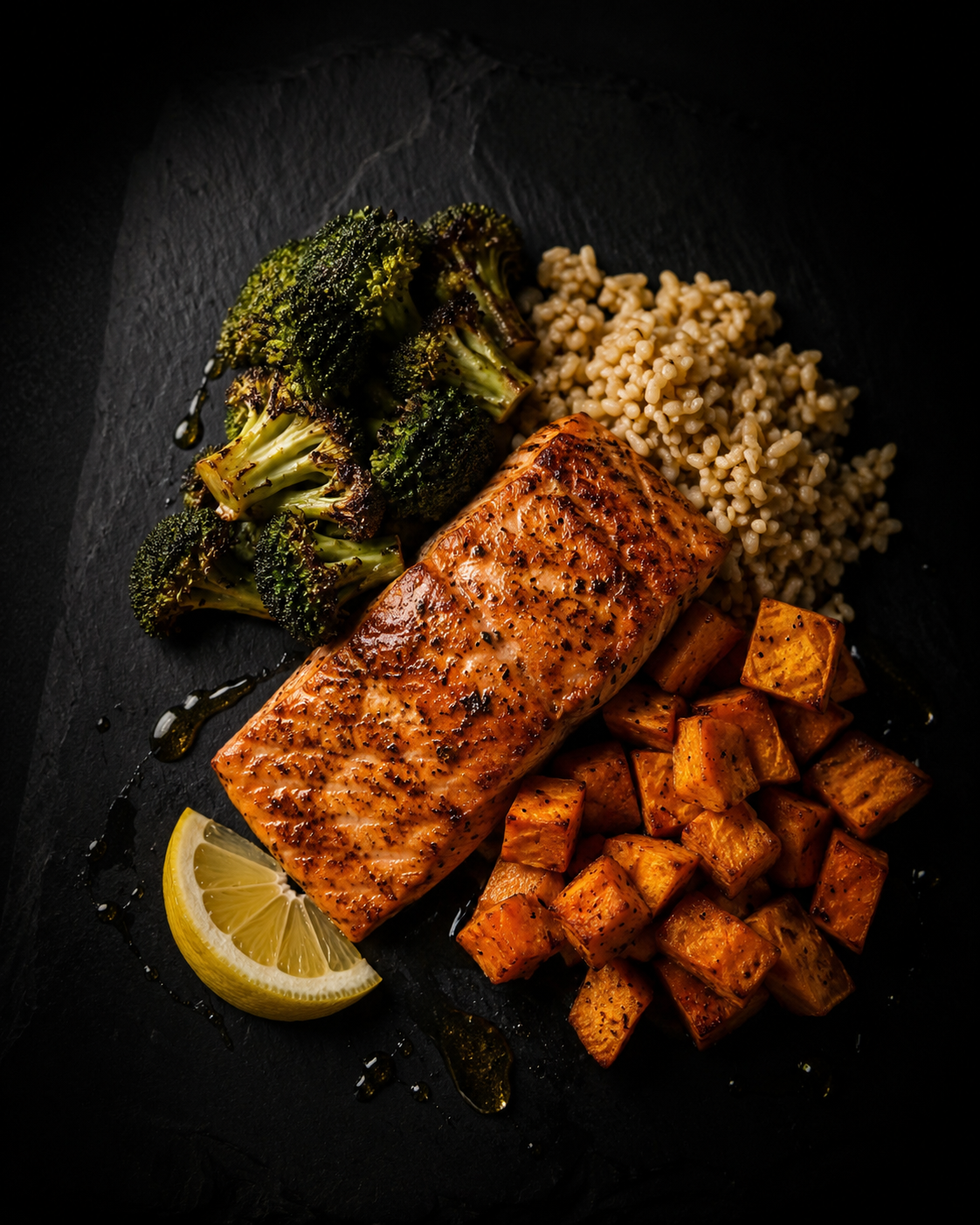
7 oz wild-caught salmon + 1 medium sweet potato + asparagus + garlic + olive oil. Omega-3s directly support testosterone production and reduce aromatization in adipose tissue.
Sleep Stack
1 cup cottage cheese (casein, slow-release overnight) + 8 oz tart cherry juice (natural melatonin precursor). 90% of testosterone is produced during sleep. Make it count.
Why lifting heavy matters.
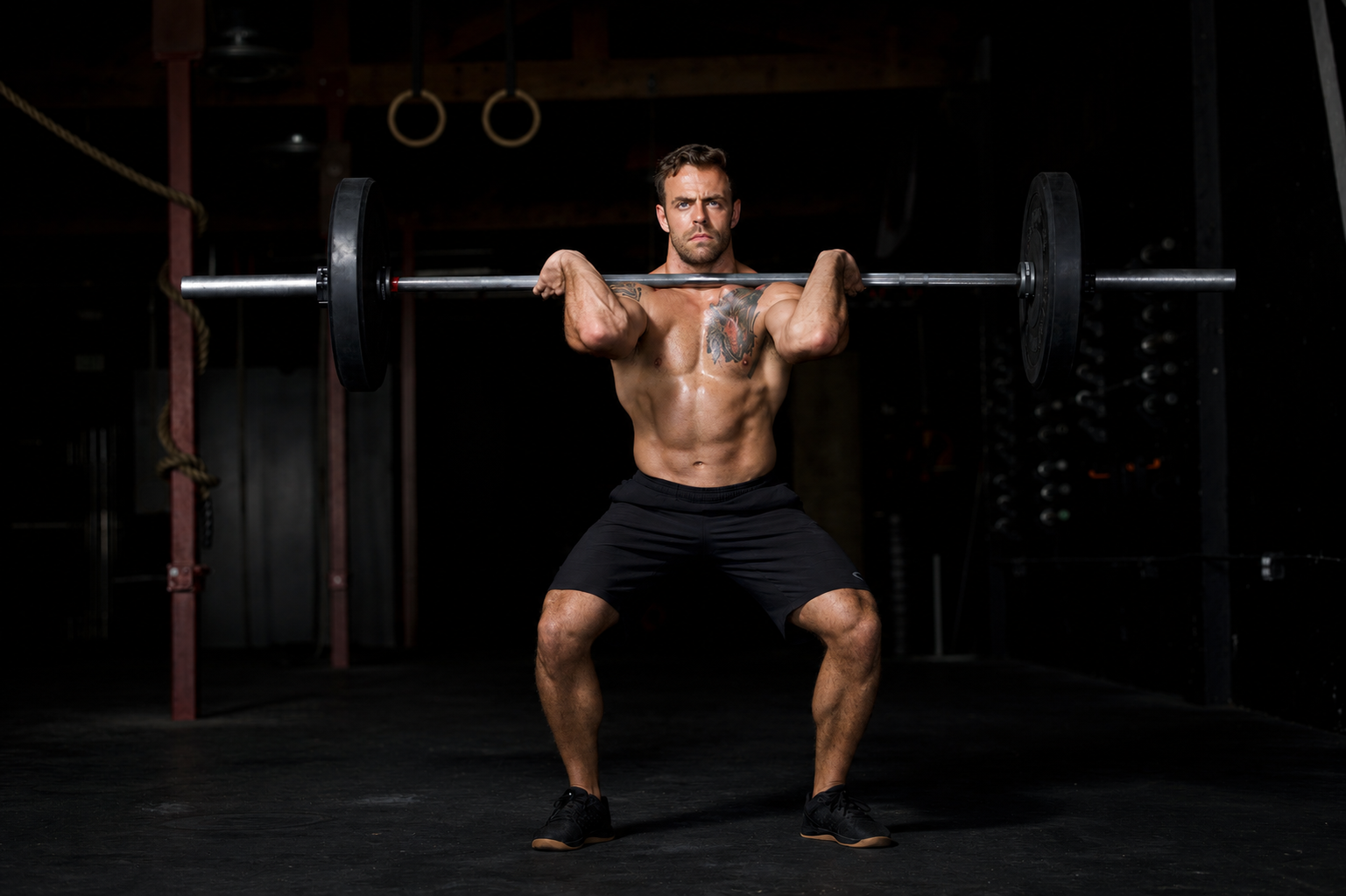
Acute T spike post heavy compound lift, versus minimal response to isolation or moderate-intensity cardio. Men who train consistently also maintain significantly higher T baselines year over year.
Heavy resistance training builds bone density at the hip and spine even in men over 65. The mechanical load is the signal. Nothing replaces it.
Average lean mass gain in 6 months of progressive resistance training starting in the 50s or 60s. Every pound raises your metabolic floor and protects against frailty.
The shift to heavy.
If you've been doing moderate-weight, high-rep circuits, you've been leaving most of the benefit on the table. Circuits are useful for conditioning. They are not the primary tool for men managing testosterone decline.
The primary tool is true strength work: 3–6 reps at 75–85% of your max on 4–6 compound lifts, with full rest between sets. Boring on paper. Right on the money in practice.
You will not become a bodybuilder. Without the testosterone levels of your 22-year-old self, that ship has sailed naturally. What you will build: visible muscle, a metabolism that responds, and the bone and joint integrity to train for the next 25 years.
You don't know what you don't know about diet.
- 203 to 190 lb
- Stronger across the board
- Feels better at 51 than at 49
The CSF Strength Plan.
Lower Day · "A"
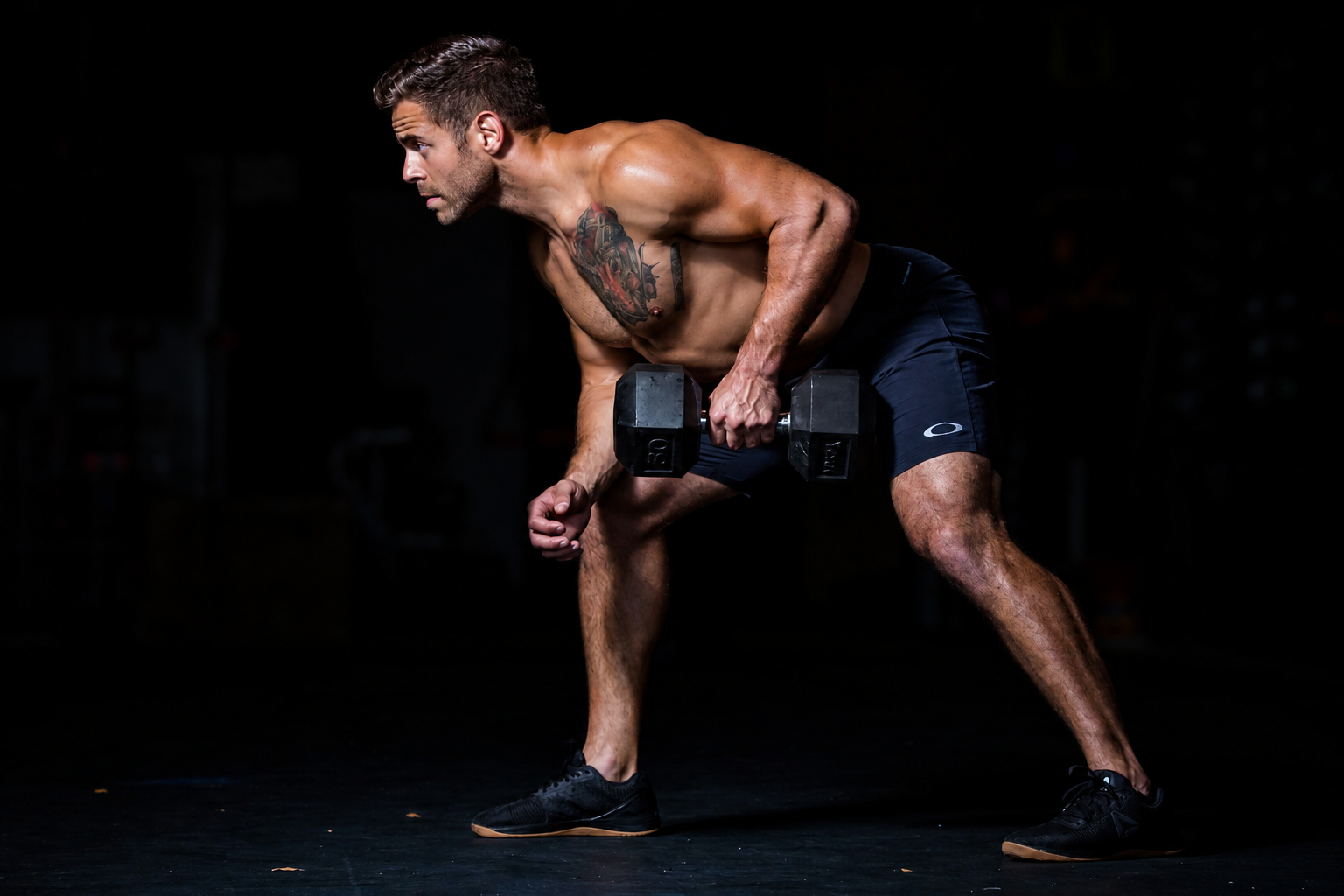
Upper Day · "B"
Cardio, upgraded.
Zone 2
2–3× / week · 30–60 minThe "nose breathing" pace. Brisk walk, easy bike, light hike. You can hold a full conversation, barely. Builds mitochondrial density, insulin sensitivity, and cardiovascular resilience without elevating cortisol enough to suppress T.
- Brisk outdoor walk · 3.5–4 mph
- Stationary bike, low resistance
- Hiking on rolling terrain
- Swimming at conversational pace
- Rucking 15–25 lb pack
Sprints / VO₂ Max
1× / week · 20 min totalShort, fully recovered intervals. The most efficient way to raise VO₂ max, the strongest predictor of all-cause mortality after 50, outperforming virtually every blood marker. Twenty minutes once a week is sufficient.
- Bike sprints · 30 sec on, 90 sec off · ×10
- Hill sprints · 20 sec ×8
- Rower intervals · 250m ×6
- Assault bike · :30 / 1:30 ×8
- Sled push · 20 yd ×10
NEAT. The forgotten lever.

The floor, not the goal. The floor.
Cuts post-meal blood sugar by ~30%.
Stand and walk 2 min. Set a timer.
Turns a walk into strength + cardio.
- → Walk every call you take
- → Park at the far end
- → Standing desk for 50% of the day
- → Stairs, always
- → Walk the dog an extra 10 min
Sedentary men have measurably lower T than active men, independent of structured exercise. Chronic sitting increases SHBG and visceral fat, both of which further suppress free T. Movement isn't optional; it's hormonal medicine.
Adding 20–30 lb to a walk adds meaningful muscular load to the hips, back, and shoulders, zones that respond to mechanical stress with bone remodeling. Zone 2 intensity. Strength benefits. No gym required.
Sleep, cortisol, recovery.
The 90-minute wind-down
Last alcohol & food
Alcohol within 3 hours of sleep cuts deep-sleep quality by 40%. If you drink, do it earlier.
Lights down · screens off
Switch to warm lamps. Phone in another room. Blue light suppresses melatonin for 2+ hours.
Cool the room
Bedroom to 65–67°F. Warm shower first, drops core temperature and triggers sleep onset.
Down-regulate
Read, journal, magnesium glycinate 300–400mg, tart cherry juice. No email. No news.
Lights out
Same time every night, ±30 min. Consistency beats duration every time.
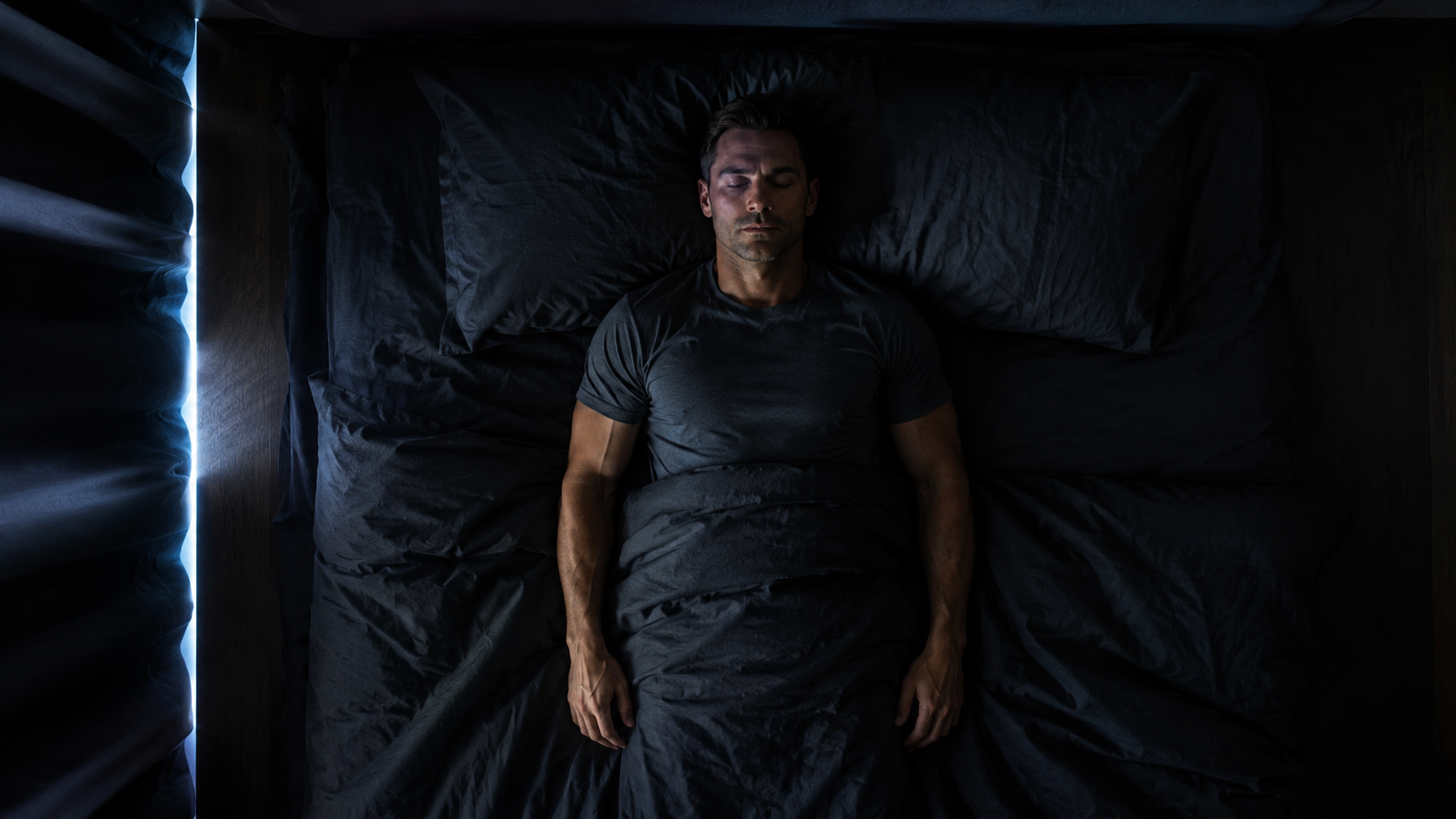
Rate your weekly stress 1–10. Anything above 7 for 3+ days means strength training drops to 2× and zone 2 doubles. Cortisol and testosterone are inversely related. A fried nervous system cannot build muscle.
Box breathing 4-4-4-4 for five minutes before bed flips you into parasympathetic dominance. Free, effective, and backed by decades of vagal nerve research. Works faster than anything on a supplement shelf.
Sauna 3× per week (15–20 min) links to improved T levels, better sleep, and stronger cardiovascular markers in men. Cold plunge post-sauna is optional, some evidence points to an acute T elevation, though the effect is modest.
Prostate & sexual health.
PSA Screening
- Age 50+: discuss PSA with your doctor
- Age 45+: if Black / African American or family history
- Age 40: if two or more close relatives with prostate cancer
- Elevated PSA can mean BPH, prostatitis, or cancer, it is a conversation starter, not a diagnosis
- Annual check-in is reasonable from 50 onward
Sexual Health & T
Low libido and ED are among the most common presenting symptoms of low testosterone, and among the most responsive to the lifestyle work in this blueprint. Before turning to medication:
- → Lift heavy and consistently for 12 weeks
- → Fix sleep (especially sleep apnea)
- → Cut alcohol significantly
- → Reduce visceral fat (aromatase lives there)
- → Address stress / cortisol
- → Get a full hormonal panel (T, Free T, E2, prolactin)
ED at 45–55 that doesn't respond to lifestyle changes is also a cardiovascular red flag. Request a lipid panel, ABI, and coronary calcium score if not done recently.
Kegel Exercises for Men
Yes, they work. For urinary urgency, for ED support, and for post-void dribble. The pelvic floor is a trainable muscle group.
- Find it: stop urination midstream, that's the contraction
- Hold: 3-sec squeeze + release × 10, three times daily
- Pulse: rapid contract-release × 20 after holds
- Integrate: exhale on effort during all heavy lifting
- Progress: add 5-sec holds weekly over 6 weeks
Mindset & SMART goals.
Reframes that work.
| "My metabolism is broken." | I have less muscle. Lifting fixes that. |
| "I'm too tired to work out." | The workout is what fixes the tired. |
| "I'm just getting old." | I'm under-trained and undersleeping. Different problem. |
| "I can't eat like I used to." | I need more protein than I used to. Different goal. |
| "It's too late to change." | The best time was ten years ago. Second best is today. |
A SMART goal that works.
Bad goal
"I want to get in shape and lose the gut."
Good goal
"By Labor Day, I will deadlift 1.5× my bodyweight for 3 reps, sleep 7 hours on at least 5 nights per week, and fit into my 36-inch jeans without discomfort."
Track what matters.
- → Waist circumference (visceral fat proxy)
- → Total T + Free T + SHBG (labs annually)
- → PSA (annually, 50+)
- → HRV trend over 4 weeks
- → Bloodwork: A1C, lipids, ApoB, Lp(a), hsCRP, vitamin D, ferritin
- → DEXA scan every 2–3 years after 55
- ↘ Daily weigh-ins
- ↘ Calorie burn on the treadmill display
- ↘ BMI in isolation (terrible for muscular men)
- ↘ "Recovery scores" you can't act on
- ↘ Chasing Total T without testing Free T
Every 4 weeks, look at the dashboard, not yesterday. Trends not snapshots. If 3 of 4 are moving up, you're winning, regardless of what the scale did this morning or how you feel on a bad sleep night.
I'm in better shape now than I was when I was 30.
- Lifting again
- Golfing again
- Walking about 5 miles a day
A word on TRT.
Questions worth asking your doctor
- → Is my Free T and Total T genuinely low, or just low-normal?
- → Have we ruled out sleep apnea, obesity, alcohol, and medications?
- → What's my SHBG, does that change the picture?
- → What delivery method fits my lifestyle (injections, gel, pellets)?
- → How will we monitor PSA, hematocrit, and estradiol on TRT?
- → What are the fertility implications if that matters to me?
- → What does success look like, and on what timeline?
What TRT is not
It's not a substitute for the work in this blueprint. Men on TRT still need to lift, eat protein, sleep, and manage stress. TRT can reduce the symptom burden enough to make the work possible, but it amplifies the work, it doesn't replace it.
It's not just for bodybuilders. Clinically diagnosed hypogonadism (<300 ng/dL total T with symptoms) is a medical condition with real health consequences, including bone loss, cardiovascular risk, and metabolic dysfunction.
It's also not for everyone. Active prostate cancer, desire for fertility, and certain cardiovascular conditions all factor in. A qualified clinician works through this with you.
Frontier tools.
Sermorelin · CJC-1295 · Ipamorelin
Stimulate the pituitary to release more growth hormone. Human data confirms GH and IGF-1 biomarker elevation. Functional muscle or body composition gains in healthy men are not robustly proven. Most commonly prescribed as a stack (CJC-1295 + Ipamorelin) at men’s health clinics, Sermorelin has the longest clinical history.
Requires a prescription. Compounding rules for these peptides changed in 2026 and are still under FDA review, so ask your clinician about current status. Purity varies significantly by source. GH-axis activation may affect glucose in susceptible individuals.
BPC-157
Body Protection Compound. Rodent injury models report faster repair signals and reduced inflammation. No robust human RCT for tendon or ligament outcomes as of 2026. The marketed “heals injuries fast” claim outstrips the available evidence substantially.
Regulatory note (updated Sept 2026): FDA restricted BPC-157 for compounding in 2023, then lifted that restriction in April 2026. In July 2026 an FDA advisory panel voted 8 to 6 to allow compounding, against the advice of FDA's own scientists. The vote isn't binding and it isn't an approval. Nothing changes until FDA completes formal rulemaking. The evidence hasn't changed either. Unregulated online sources still carry real purity and contamination risk.
PT-141 · Bremelanotide
The most evidence-backed peptide for testosterone-related sexual symptoms. Works via the melanocortin pathway, centrally, not vascularly, making it complementary to PDE5 inhibitors rather than competitive. FDA-approved for HSDD in premenopausal women; off-label use in men for ED and libido is studied and widely practiced in men’s health clinics.
Common side effects: nausea (most common), flushing, headache, transient blood pressure increase. Requires clinician oversight and prescription.
Tesamorelin Truth Score 8/10
FDA-approved GHRH analog. Human RCT evidence supports visceral adipose reduction in HIV-associated lipodystrophy. Off-label for general visceral fat is studied. Strongest evidence for body composition of any GH-axis peptide. Requires Rx.
Kisspeptin Emerging
Stimulates the LH/FSH cascade upstream, potentially restoring the body’s own testosterone production rather than replacing it. Particularly interesting for secondary hypogonadism. Early clinical trial data is promising. Watch this space over the next 2–3 years.
Thymosin alpha-1 Truth Score 5/10
Immune modulation with human RCT evidence in specific contexts (hepatitis B). Not a general wellness peptide, clinician-guided use only for evidence-based indications.
- Target: Is there a real human receptor/pathway for this claim?
- Delivery: Can it actually reach the target tissue?
- Outcomes: Do humans show meaningful results, not just biomarkers?
- Risk: What happens if you’re wrong, money, time, side effects, contamination?
Frequently asked.
Two mechanisms running at once. First, declining T shifts fat storage toward visceral/abdominal, that's the T-to-estrogen ratio at work in adipose tissue. Second, if you've lost even 5–6 lb of muscle over the past decade (very common, rarely noticed), your resting metabolism has dropped meaningfully. Same calories, less muscle = different result.
The fix isn't to eat less. That accelerates muscle loss and further suppresses T. The fix is lift heavy, anchor protein, fix sleep. Visceral fat responds to training faster than subcutaneous fat. 12 weeks of consistent effort shows real change.
Yes, acutely and chronically. Heavy compound lifts (squat, deadlift, press, row) produce the largest acute testosterone and growth hormone spike of any training modality. And men who train consistently over months maintain measurably higher T baselines than sedentary men of the same age.
It's not TRT-equivalent, nothing you do in the gym will replicate a pharmaceutical intervention. But it's the most potent natural stimulus available, and it's free. Do it first. Evaluate everything else after.
Maybe. But low T is commonly blamed when the actual culprits are sleep apnea (often undiagnosed), thyroid disorder, iron deficiency, clinical depression, or just chronically poor sleep hygiene. Before assuming it's T, get full labs: CBC, comprehensive metabolic panel, TSH, ferritin, testosterone (total and free), and, if you snore or wake unrefreshed, a sleep study. Fix what you can measure before supplementing what you can't.
It is not. The evidence here is unambiguous. Men in their 60s and 70s build muscle, restore bone density, and improve cardiovascular fitness from a cold start, with progressive resistance training. The timeline is longer (16–24 weeks to see significant change rather than 12). The process requires more patience and more protein. But the body's response is real, and it does not require youth to happen.
Start with the Monday and Wednesday sessions only. 45 minutes each. Light loads, build the movement patterns, then add load. Two days turns into three. Three turns into a habit. That habit is everything.
That question belongs to a qualified clinician with your labs, history, and symptom picture. What we can say: don't pursue TRT until you've trained consistently for 90+ days, fixed sleep (addressed apnea if relevant), anchored protein, and reduced alcohol. Many men find their symptoms resolve substantially without TRT when those levers are pulled correctly.
If you've done that work honestly for 3–6 months and symptoms persist with confirmed low labs, then TRT is a reasonable conversation. In that order.
More compatible with male physiology than with perimenopausal women, but still a tool, not a solution. If your fasting window compresses protein below your daily target (and for most men doing 16:8, it does), you're trading muscle for a protocol. Protein distribution matters: 3–4 meals of 40–50g each drives muscle protein synthesis better than 2 large meals of 80g each, regardless of total intake. If fasting helps you eat less junk and more intentionally, fine. But hit your protein first.
Yes. Our 1:1 coaching for men is built around your stage, labs, symptoms, schedule, and history. We customize training, nutrition, and recovery protocols, and provide 7-day messaging plus weekly video check-ins. If you'd like to see if it's a fit, book a free 45-minute strategy call on the next page. No pressure, no pitch. Just a real conversation.
Run this blueprint yourself. Genuinely. Fix sleep first, including getting screened for apnea if you snore. Then lift three days a week, heavy. Then anchor protein. In 90 days you'll have a meaningfully different baseline and a much clearer picture of what else you need. When you're ready for a coach, we'll be here. We aren't going anywhere.
You aren't slowing down. You're under-trained and undersleeping. Fix that first.
Don't do this alone.
This guide is educational, not medical advice. It summarizes published research and our coaching experience. Talk to your doctor before changing medication, supplements or hormone therapy.
Free · No spam
Send me this guide.
We'll email you a link so you can finish it later.